Software Engineering in Web Development, Backend Services, and More

Category: Articles (Page 94 of 258)

Personal opinions and how-to’s that I’ve written both here and as contributions to other blogs.

Homebrew, Node, and Gulp for WordPress Development

Though I have a suite of tools I prefer to use on projects that I work on from the ground-up, the nature of contract work is that you’re not always able to use those tools.

Instead, you have to work using the tools provided by the client which usually come into play whenever you inherit a project from a previous developer.

To be clear, this isn’t knocking anyone’s choice of tools. I don’t have a position here or there on that. Instead, I think it’s import to know how to get up and running with some of those tools easily.

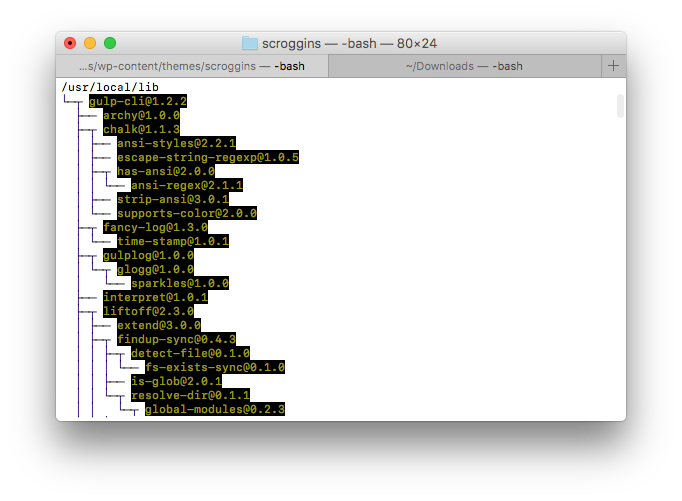
Homebrew, Node, and Gulp: Terminal Installation

For example, we’ve been working on a project that requires Gulp which in turn requires Node which can be installed easily using Homebrew. It’s a lot of steps to work backward, right?

To get started with Homebrew, Node, and Gulp in WordPress development is pretty easy. I’ve outlined the steps below and done what I can to explain what each package does so you know what you’re installing and what you’re doing if or when you encounter a project like this.
Continue reading

Direct Database Queries in WordPress

If you got back through any of the posts I’ve written in the last, say, two years, you’re likely to find me advocating using available APIs over directory database queries nearly every single time.

And the truth is that I still lean in that direction. That is, if there’s an abstraction or an API that’s available for doing something specific, then I try to use it.

But in a couple of recent projects, I’ve been working with some relatively large datasets (large in comparison to non-enterprise level datasets). And in doing so, I have tried to make sure the updates to the data are as fast as possible.

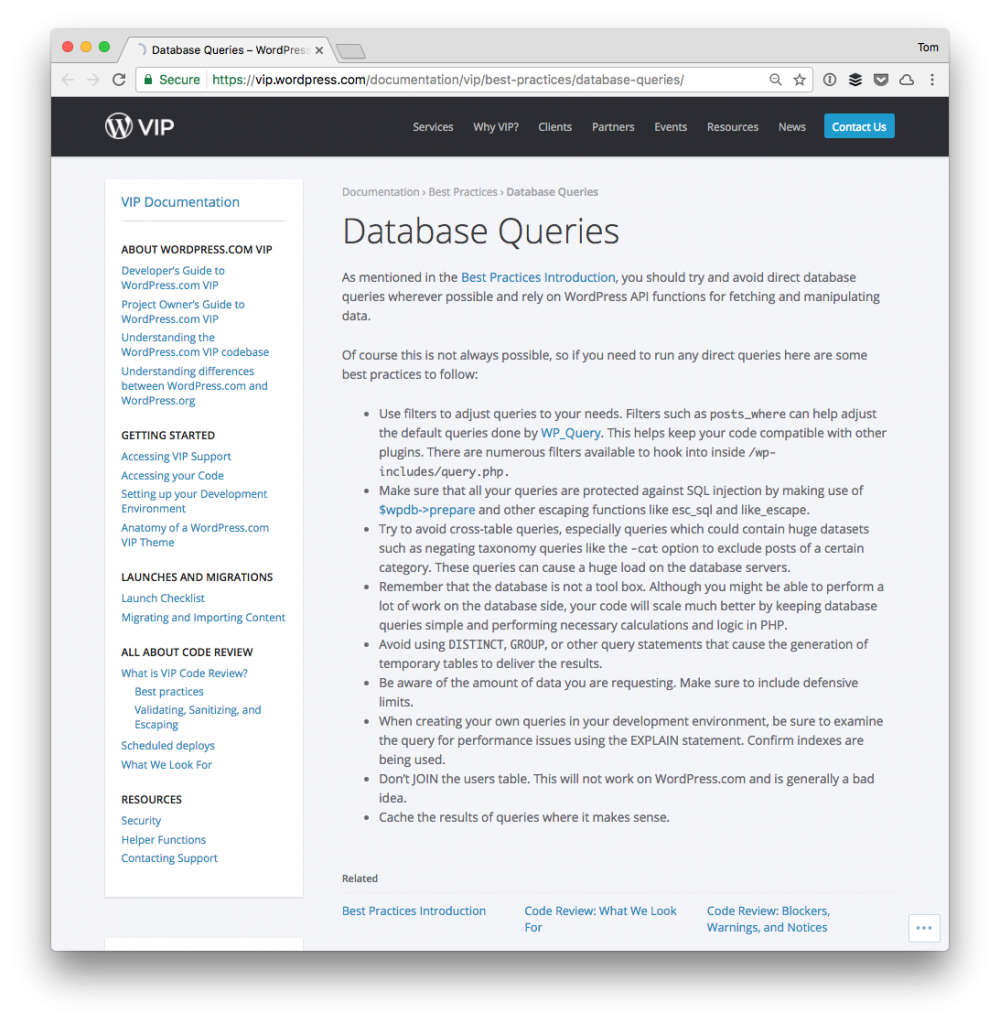
Direct Database Queries for WP VIP

In situations like this, though the WordPress Coding Standards don’t like it, I find direct database queries occasionally to be the best option for doing so under certain conditions.

Continue reading

Using the PHP Interpreter When Working With WordPress

Recently, I’ve been working on a project that requires a lot of work with dates. Depending on the nature of the work, there are times in which this can be easier than others.

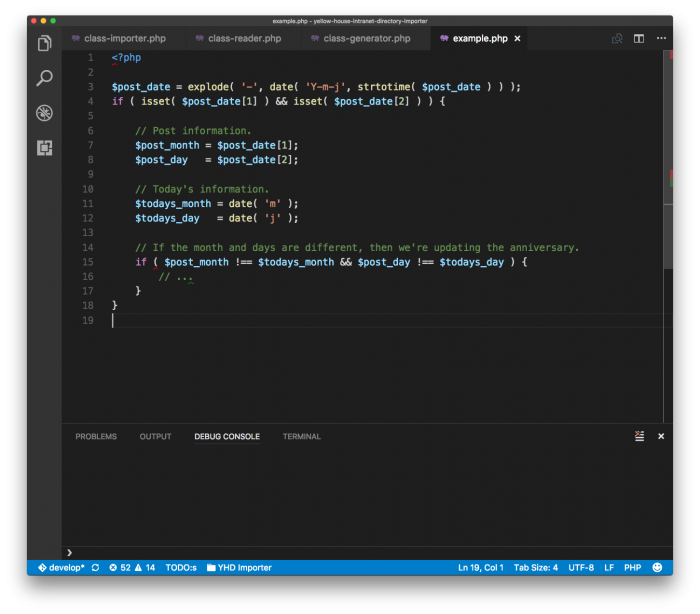
Using Visual Studio For Date Comparison

On the one hand, if you’re making a simple comparison between, say, the values of two months then that’s not a big deal. On the other hand, if you’re dealing with months, days, years, the current date, timezone offsets, and different formats, then it can be a bit more complicated.

The point of all of the above, though, is not about strictly working with dates. Instead, it’s about the challenges that come with needing to write, test, and work with source code.

And if you’re in the habit of writing code, testing it in a browser, doing some form of debugging or dumping information onto a screen, and then repeating the process, there are easier ways to deal with this.

Continue reading

Load All WordPress Custom Fields via Database Query

When retrieving information from the WordPress database I prefer to avoid using direct database queries, but there are times in which they can be useful (and it’s important that it’s done right).

One use case in which it might be helpful is when you need to retrieve a set of data of a single type. Case in point: Say you need to load all WordPress custom fields.

At the time of this writing, there’s no function of which I’m aware that will do this, so here’s how I query the database to do so.

Continue reading

Team Communication (It Matters More So Than Your Tools)

Since bringing on a couple of contractors, one question that others ask is:

oWhat is it like to go from working on projects by yourself to working on projects with a team?

Or, more simply, what’s it like having contractors? The short answer is that I dig it because it affords some advantages:

  • we have to have a sharp division of work,
  • the business can take on more projects,
  • we’re able to collaborate on things (which is something I miss about flying solo),
  • and more.

The other side of this, though, is that I feel like I have to learn what it’s like to start a business all over again.

Team communication can feel like starting all over.

Like starting with a blank slate.

This, by no means, is a bad thing. It’s the opposite. But when you go from working on projects on your own and developing your setup, then there’s a period of adjustment that happens.

I’m still experiencing this and working through it. It requires both conversations with your team and a bit of introspection to determine if what you’re doing is still right for the way you work or if you should adjust it.

Continue reading

« Older posts Newer posts »

© 2026 Tom McFarlin

Theme by Anders NorenUp ↑