Software Engineering in Web Development, Backend Services, and More

Author: Tom (Page 188 of 434)

One Month with Boxy (Inbox By Google)

If there’s one thing about which I’m consistent, it’s consistently trying new things and moving something that better fits my workflow whenever the need arises. And such is the case with Boxy.
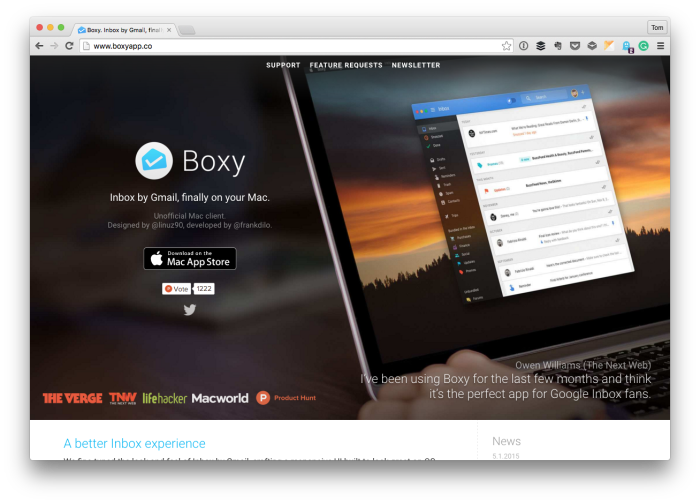
Boxy

But let me back up: A few months ago, I talked about Kiwi. A desktop Gmail client for Mac that I [still] think is great if you’re a fan of the original Gmail interface (that is, say, in contrast to Inbox).

The thing about Inbox is that I wanted to like it, and I wanted to use it. The problem is that I like having a consistent a consistent experience across my phone, tablet, and my desktop.

It’s a personality quirk, I know.

But still, the only available versions were the iOS version and the version that ran within a browser. Now don’t get me wrong, I’m a big fan of web applications, but there’s something about having email as a separate application rather than a browser tab that works better for me.

Another personality quirk, maybe?

Continue reading

Should WordPress Product Support Be In-House?

When asked if product support is done in-house by the company who built the product, the easy answer appears to be yes, doesn’t it? I mean, why would you have it any other way?

More specifically, why would you have someone who doesn’t work for your company handle support for something you (or you and your team) built?

Sure, there are loopholes – a phrase I use loosely in this post – for this like hiring someone to work for your company who can be a dedicated resource to handling support of the product when they aren’t as familiar with the product.

But when that happens, I think the lack of experience shows when you start to get into slightly more complicated issues.

Continue reading

The Advantages of Creating an Interface

In web development, I think many who here the term “interface” or who talk about “creating an interface” usually refer to how the page, site, or graphics will look.

And that’s completely normal because when the majority of outlets – presentations, news, articles, media, etc. – talk about the way something looks as it relates to technology, they always talk about its interface.

Not to mention, it is the correct term.

But when it comes to object-oriented programming, the idea of creating an interface is a bit different. Rather than referring to the way a program looks, you could say that it has more to do with how it functions.

Even that isn’t necessarily the proper definition, but it’s close enough. If you’re an experienced programmer, then you’re likely already familiar with this idea.

But if you’re someone who’s just getting into object-oriented programming (specifically using PHP in the context of WordPress), then maybe this will help when designing the architecture of your next project.

Continue reading

Don’t Over-Engineer Your Project

Over the last few days, I’ve been building the site that’s going to power the membership aspects of the WordPress Development course I’m working on. Initially, I went into the project like any other developer: I was ready to sit down, start writing code, handle a bunch of configuration, and generally tweak my WordPress installation at a level that I was convinced would take me a long time.

But it wasn’t like that at all.

And that’s something I know developers are plagued with more often than they – or we – would like to admit:

We over-engineer our solutions all of the time.

It doesn’t have to be like that, though. It takes a slightly different approach and it requires that we fight our natural inclinations, but it can be done.

It just requires a more pragmatic approach.

Continue reading

Sharing Project Files on OS X

If you’re used to working on OS X or a Linux-based distribution and you need to share project files with a peer, it’s not always as easy as being able to drop a file in Dropbox or send a single file via email.

Case in point: Whenever I work on screencasts or demo videos for client files, I use Screenflow in order to capture video and audio. But because of the way I setup screencasting, I use a separate user account on my machine.

This means that I need to share project projects between the account used for screencasting and the account I use for everything else.

Continue reading

« Older posts Newer posts »

© 2026 Tom McFarlin

Theme by Anders Noren — Up ↑