Software Engineering in Web Development, Backend Services, and More

Tag: WordPress (Page 100 of 220)

Articles, tips, and resources for WordPress-based development.

The Tension of Refactoring Legacy Code, Part 3

The last two posts have talked specifically about what it’s like to work specifically on refactoring legacy code whether it be something that we’ve previously worked on or something that we’ve inherited from someone else.

  • In the first post, I talked about the idea of “leaving the campground cleaner than you found it” which is the Boy Scout rule applied to programming.
  • In the second post, I talked about getting a bit reflective about the choices we’ve made as it relates to some of the code we encounter in our work and how it can affect our self-confidence or our ability.

And though I think there’s more than can be said as it relates to this topic (I mean, it has the potential to be a very long discussion, doesn’t it?). I want to shift gears a little bit and talk about what it’s like to try to more modern code on top of what’s essentially a legacy application.

Specifically, I want to share a few thoughts on what it means to write code (that will likely need refactoring at some point) on top of WordPress.

Note: This post ended up being much longer than I anticipated, but I hope you read it in its entirety, enjoy it, and feel free to comment on it, as well.


Continue reading

The Tension of Refactoring Legacy Code, Part 2

In the previous post on refactoring legacy code, I talked a bit about the challenges that we face not only as WordPress developers but as programmers in general as it relates to working with legacy code.

The short of it is that I believe we want to make sure the codebase is as optimized, clean, and well-organized as possible. But the reality of a project prevents us from doing this.

Deadlines can prevent us from refactoring legacy code.

Perhaps it comes in the form of the team we’re on; perhaps it comes from deadlines that are looming, or perhaps it comes from something else.

Whatever the case, we’ve established that a tension exists. And though I’ve talked about some general ideas as to how to deal with it, I haven’t really talked about my own experience in doing so.

Continue reading

The Tension of Refactoring Legacy Code, Part 1

In a post last week, I talked about various problem spaces that exist in WordPress, but I also briefly touched on the idea of practical applications as it relates to writing WordPress-specific solutions.

Specifically, I made the comment (more or less in passing):

When I was in school, I had to take a class in Computational Theory. For the most part, I’m more of a fan of practical application, but I know that much of said practical applications are the concrete implementations of proven theories.

And then I went on to talk about more theoretical topics as it relates to solving problems in a given computing space (for us, that’d be WordPress).

Computational Theory

Since I spoke about the previous topic at this particular level, I thought it might be fun talk about a more accurate or more practical approach to writing WordPress-specific software.

Recently, I’ve been working on a codebase that’s a few years old. The desire to want to refactor the whole codebase is strong (and I know I’m not alone in feeling this way when it comes to working with previous projects).

But this is not pragmatic, and it’s not so for some different reasons. So over the next three posts, I thought I’d share a little bit about the state of the project, managing the tension that exists, and how to do what we can when we’re faced with this type of situation.

Continue reading

The Modern WordPress Server Stack

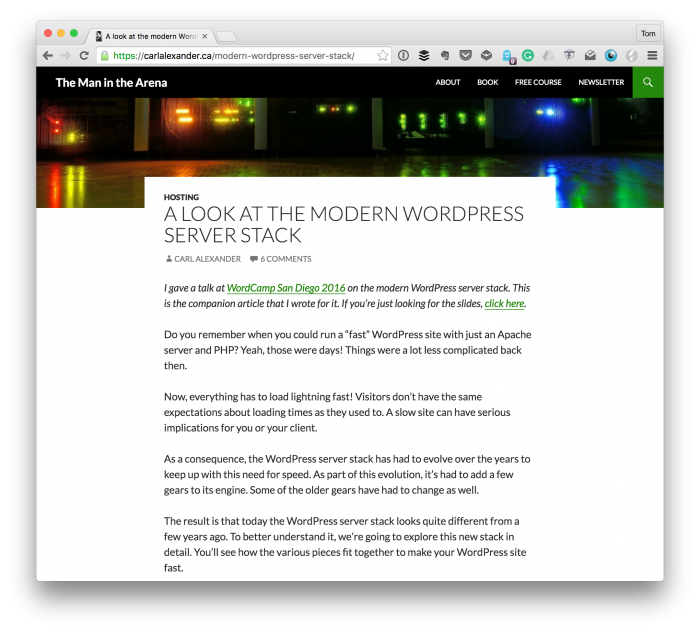
During WordCamp San Diego, I had the pleasure of meeting and hearing Carl Alexander speak on the topic of the modern WordPress Server Stack.

Modern WordPress Server Stack

A few notes:

  • If you’re not following Carl on Twitter, I recommend it. He’s an incredibly smart person who is doing some really neat things with WordPress.
  • If you’re not subscribed to his blog but are interested in advanced programming topics as it relates to WordPress, I recommend subscribing.
  • If you weren’t present for his talk, you can catch it on WordPress.tv.

With that said, Carl also included an article that accompanied his presentation on his blog and it’s something that I think makes for good reading.

I find this especially true if you’re someone who is at an intermediate level of WordPress development or if you’re someone who’s looking to learn more about server administration.

Continue reading

Thinking Through Problem Spaces in WordPress

I enjoy talking with fellow developers about the problems they are thinking about as it relates to their field, and the problem spaces in WordPress is no exception.

That is, I enjoy hearing about what they are working on, what they are thinking about, or what they are tinkering with as it relates to their primary line of work.

Tinkering

For many who read this blog (and this includes myself though I’m the one actually writing it), we spend a lot of our time working within the WordPress space but does mean we spend a lot of time thinking about the WordPress space? Furthermore, does this mean that we spend a lot of time thinking about problems and potential solutions to what we see in our area?

First, this is not something that’s unique to our space. I believe that you can find this in any programming community.

Secondly, I think that this notion of thinking about a particular set of problems is something that’s a bit more abstract than what we usually discuss or see written about on other blogs.

Continue reading

« Older posts Newer posts »

© 2026 Tom McFarlin

Theme by Anders NorenUp ↑