Software Engineering in Web Development, Backend Services, and More

Tag: WordPress (Page 87 of 220)

Articles, tips, and resources for WordPress-based development.

Uploading Files to a Custom Directory in WordPress

As it relates to uploading files in WordPress, the CMS offers some convenient API functions that make it easy for developers.

Uploading Files to a Custom Directory

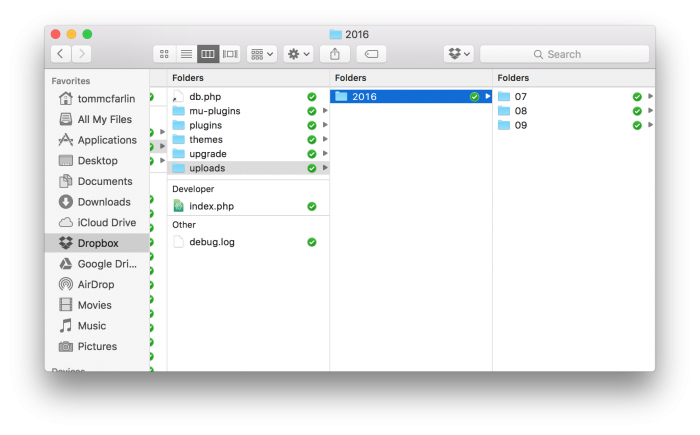
The standard uploads directory in a WordPress installation.

Some of these functions include:

These functions, though, often require us to limit our files to the uploads directory. And many times, that’s great. It gives us a single place to store our files and it gives us one place to retrieve our files when needed.

But if you’re working on a web application or even an advanced plugin, this isn’t always the ideal situation. For example, let’s say that you have a plugin in which you want to have your own uploads directory, and that’s where you want to store your files.

What do you do in that case?

Continue reading

Updating Atom and the WordPress Coding Standards

For those who have read my Atom and WordPress Coding Standards post, then you should have everything you need when it comes to setting up the editor to evaluate your code with the WordPress Coding Standards.

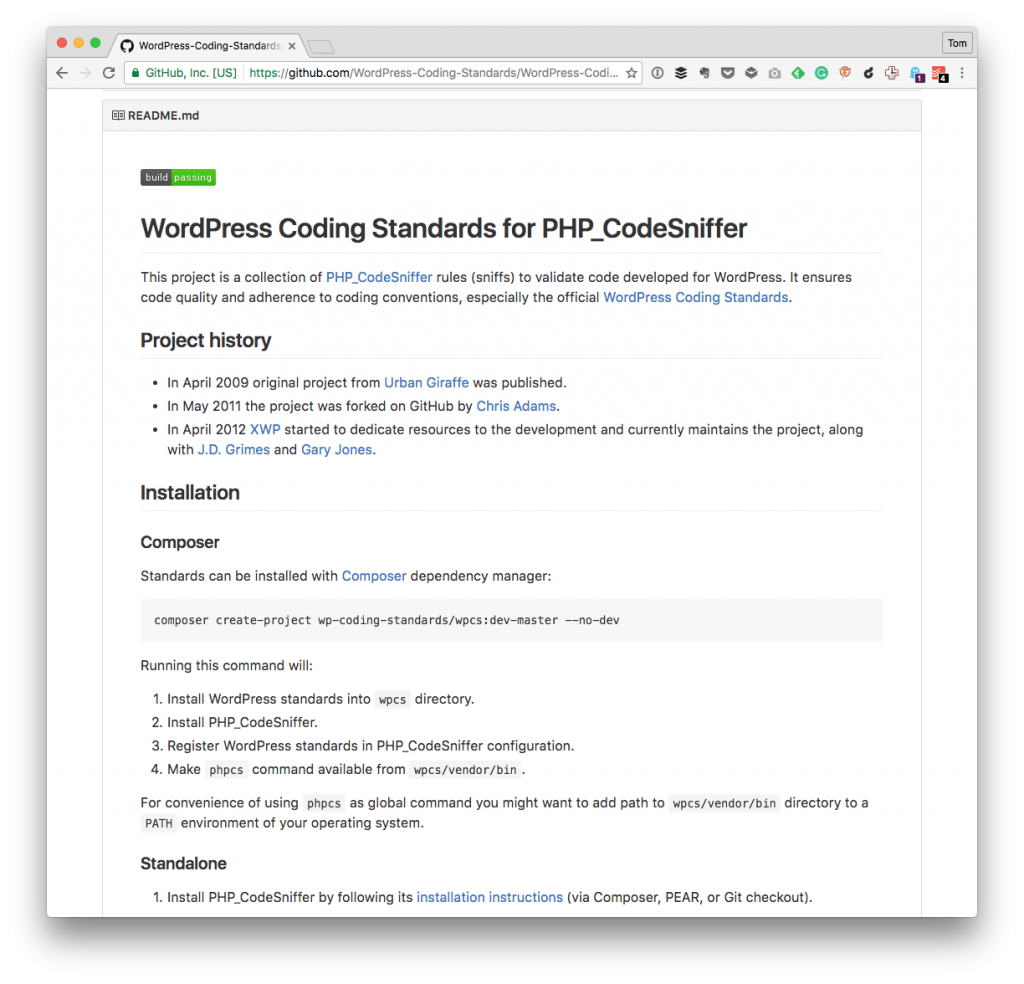
Recently, though, the 0.10.0 release of the coding standards were published on GitHub, and it brings a lot of changes.

Atom and the WordPress Coding Standards

If you’re looking to begin upgrading to this new change, there’re a few caveats that you may experience when working with Atom and the WordPress Coding Standards.

They’re easy to address, though.

Continue reading

Singleton Design Pattern and Dependency Injection, Part 3

In the previous two posts (available here and here), I talked a bit about the Singleton Design Pattern, dependency injection, and dependency injection containers.

Singleton Design Pattern as a Dependency Injection Container

Not that kind of container (but it’s still a cool shot).

These are all topics that I think are important for developers to know and to understand. If you’ve not read the previous posts, then I recommend it because the code that’s shown later in this post assumes you know a little bit about each of the topics mentioned above.

Furthermore, this is going to be a bit shorter as it relates to the previous two posts. The purpose is simply to show how to use a singleton as a simple dependency injection container.

Continue reading

Singleton Design Pattern and Dependency Injection, Part 2

In the previous post, I said that I was going to talk about how to use the Singleton Design Pattern as a simplistic way to introduce a dependency injection container into a project.
The Singleton Design Pattern and Dependency Injection Containers

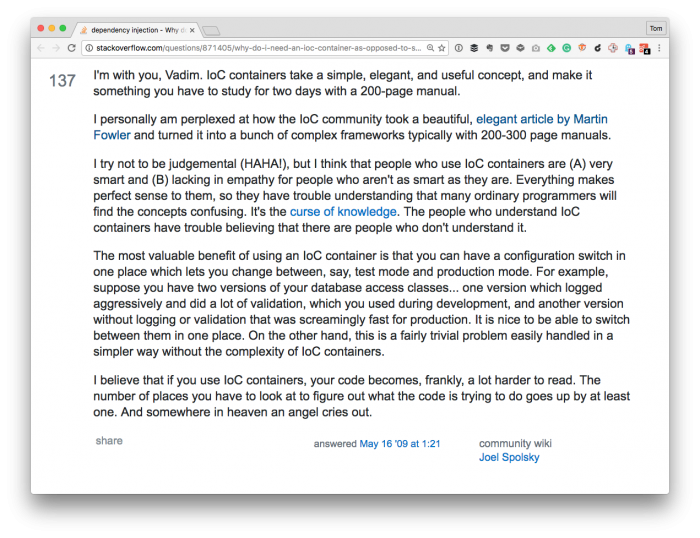
One of the best comments I’ve seen about dependency injection containers comes from Stack Overflow (and Joel Spolsky, even):

IoC containers take a simple, elegant, and useful concept, and make it something you have to study for two days with a 200-page manual.

And there’s a time and a post for where I could digress, but that’s not this post. Instead, there are a few nuances about this idea that I want to clarify before I go any further:

  1. Dependency Injection Containers are more than just ways to store objects. They handle other additional logic. I’ll cover more about this later in the article.
  2. I don’t recommend sticking with an implementation of the Singleton Design Pattern for a container (or for very many things, for that matter).
  3. The purpose of showing this as a strategy is a way to show how you can take a project with a tight deadline, a desire to use software development best practices, and find some practical middle ground.

All of that to say is that what I’m going to show is not what I consider being a best practice for using dependency injection containers.

Instead, it’s a way to “meet in the middle” when it comes to working under pressure for building solutions for others all the while not wanting to sacrifice sound engineering principles.

Continue reading
Singleton Design Pattern and Dependency Injection, Part 1

The Singleton Design Pattern is something that I’ve talked about before in previous articles.

As Wikipedia so eloquently defines it:

In software engineering, the singleton pattern is a design pattern that restricts the instantiation of a class to one object. This is useful when exactly one object is needed to coordinate actions across the system.

If you’ve done any work with object-oriented programming and familiar design patterns, then it’s likely that you’ve come across it (if you haven’t used it).

Depending on who you ask, the singleton design pattern may be treated as an anti-pattern, like some weird use of a “poor man’s namespace,” or one of the many other negative views of it.

Though these perspectives aren’t necessarily wrong, there are times where it’s okay to use it.

Continue reading

« Older posts Newer posts »

© 2026 Tom McFarlin

Theme by Anders NorenUp ↑