Software Engineering in Web Development, Backend Services, and More

Tag: WordPress (Page 64 of 220)

Articles, tips, and resources for WordPress-based development.

WordPress Project Milestones: Scoping Them For Clients

Up until the last year, one of the ways that I’ve scoped milestones is based heavily on the perspective of how I or my team and I were to be working the project.

There’s a problem with this approach, though: For those of us who try to include client feedback throughout the development process, it’s not as easy for them to take the jargon we use and still have them make sense of it.

To that end, I’ve started scoping WordPress project milestones a little bit differently so they are a bit more customer-friendly all the while still making sense to how a team of developers can accomplish what’s necessary to make sure things are functionality.
Continue reading

Maintaining a Post Status When Updating a WordPress Post

I just finished a feature for a project that uses a combination of custom post types, data imports, and updating existing posts when deleting a user (or set of users).

There’s one problem, though:

Say have you have a post that’s currently published (that is, it’s ‘post_status’ is set to ‘publish’) but, when you update the post via wp_update_post, its post_status attribute is set to ‘future.’

In order words, whenever you programmatically update a post, the status of the post is set to ‘Scheduled’ (according to the UI) and ‘future’ (according to the database column).

So what gives?

Continue reading

Inheriting WordPress Projects: Tips For Development

If you’re running a business that focuses both on developing solutions from the ground-up or that focuses on implementing a custom solution in the context of pre-existing projects (or maybe both), then you’ve likely – at some point – been in the situation of inheriting WordPress projects.

Tackling projects from either handle brings its set of challenges – most of them welcome  – but it seems to be far more common place for people to complain about working with a pre-existing codebase.

It’s not that I don’t get that feeling, but I do think there’s a level of immaturity in doing that. On the one hand, yes some codebases are outright terrible. But then some codebases aren’t that bad. In fact, I’d argue they are just a little bit different from how you’d develop it.

This is a case in which standards come into play, but I digress on this for now.

So let’s say you’re inheriting WordPress projects and you’re not particularly stoked about the codebase with which you’re working. How is it that you can still enjoy the work that you’re doing without feeling like you need to critique every aspect of whatever it is with which you’re dealing?

Continue reading

Thoughts on Community-Based Support Forums

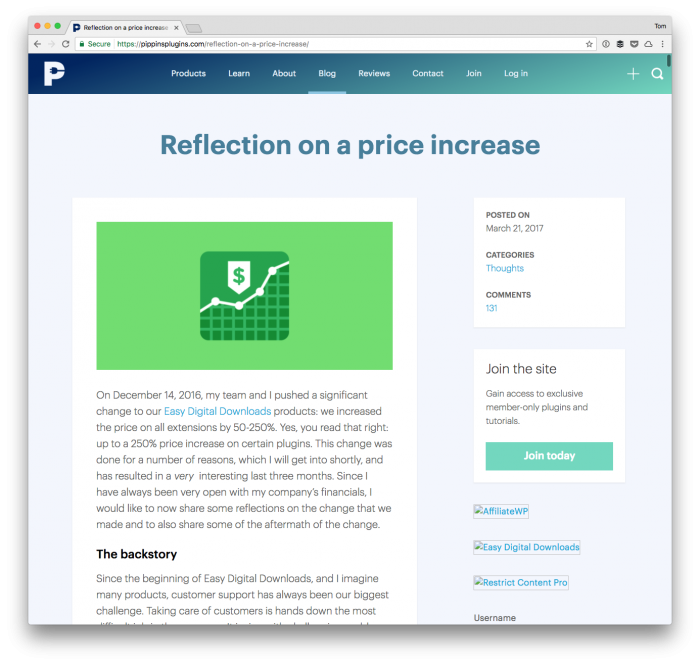
Last week – and this weekend – I’ve been reading the comments on Pippin Williamson’s posts about his company’s decision to adjust prices on Easy Digital Downloads (and for those who are curious, I applaud it).

That’s a conversation in and of itself, and there’s a long comment thread that I think is worth reading for anyone involved in WordPess product development, but I digress as that’s the point of this post.

Reflections on a Price Increase

Some readers have left comments throughout the comment feed discussing the notion of community-based support forums. The whole thread is worth a read but:

  1. EDD used to offer community-based support forums (in addition to their other support),
  2. I’ve built and worked on products that had community-based support forums

And, in retrospect, I absolutely do not think it’s a wise decision for a WordPress-based product shop to offer them. I have my reasons, I’ll elaborate, but I want to be clear that I’m constraining this strict to WordPress because it’s what I know.

I can’t speak for any other segments of our industry.

Continue reading

Working with PHP Sessions and WordPress

Earlier this week, I was talking with a friend and fellow developer about how I handle sessions in WordPress. Specifically, we were talking about how we take PHP Sessions and WordPress and make them work together (or how we adapt the former into the latter).

This is occasionally a point of interest for WordPress developers since WordPress, as an application, is stateless.

The neat thing, though, is that it gives us a variety of ways to approach this problem. But we’re not the first (and we definitely won’t be the last) to come across this problem.

Continue reading

« Older posts Newer posts »

© 2026 Tom McFarlin

Theme by Anders NorenUp ↑