Software Engineering in Web Development, Backend Services, and More

Tag: WordPress (Page 137 of 220)

Articles, tips, and resources for WordPress-based development.

Using Transients For Storing Google Maps Data

A couple of weeks ago, I shared a quick tip on working with multiple InfoWindows with the Google Maps API specifically within the context of WordPress.
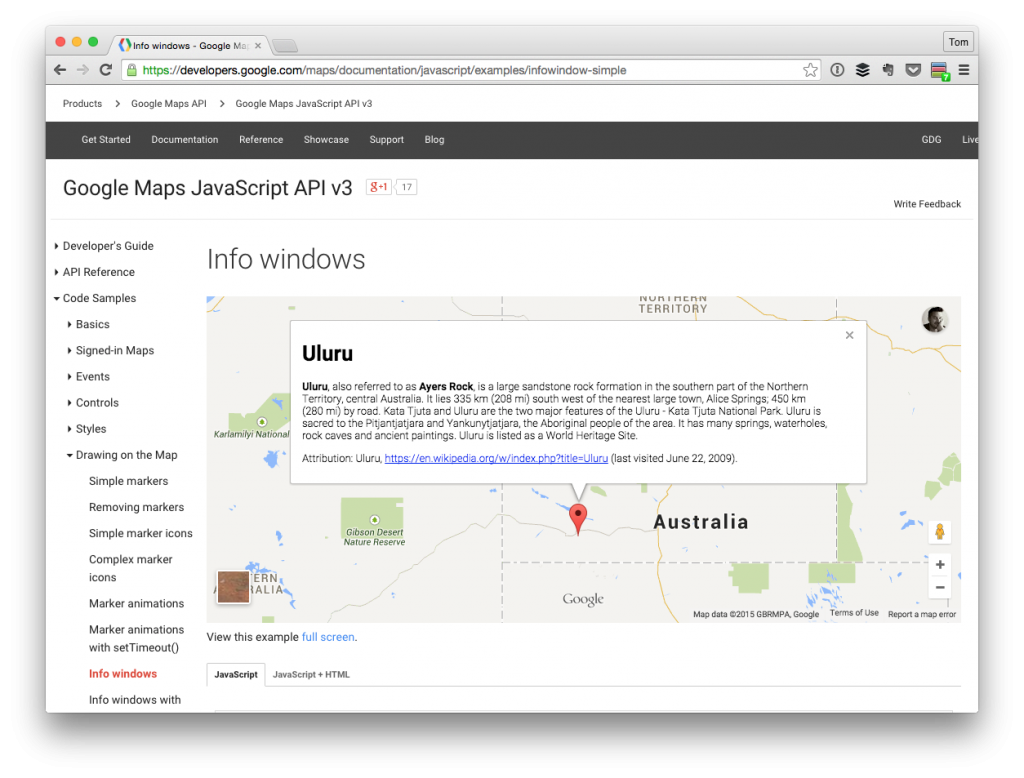
Google Maps InfoWindow

When working with this API, there are a number of considerations to take into account each of which is going to depend on how much of the API you’re going to be using; however, one constant that’s going to remain regardless of how much you’re using is the rate limit.

That is, unless you’ve paid Google a decent chunk of change, then you’re going to have to take rate limiting into account whenever you’re working with this API. And if you’re charting quite a few locations for, say, several different pages or several searches, then you can hit that limit quickly.

If you’re not at the point where you can pay Google to up the rate limit, but you’d like to still make sure your project doesn’t totally bomb out if the rate limit is hit, then I recommend using transients to store Google Maps data for an interval of time so that you aren’t making frequent calls to the API.
Continue reading

Aesop Story Engine and WordPress (Why Do We Reject Our Own Innovation?)

For some time now, I’ve been a big fan of using WordPress for web application development, but I think that developers actually embracing the CMS (let alone seeing the CMS) as a foundation for something like that is still a couple of years off.

Sure, we’re going to see some people using it for things like that. I mean, we’re already seeing some out-of-the-box applications like AppPresser, but projects like that are the exceptio, not the rule. In my own experience, I’ve found that clients are very interested in using WordPress, but using it for more application-like capabilities.

This doesn’t mean that gigs for themes, plugins, and what not are slowing down, but that people are wanting web applications for themselves or their companies, but want to be able to administer it using the WordPress dashboard or using a some custom front-end work.

But that’s beside the point.

What I’m getting at is that as developers, designers, and other people end up seeing WordPress as potential foundation for web application development, the more innovative things we’re going to see entering the space.

Continue reading

A Case For Dependency Management with WordPress

Yesterday, I came across a comment that was in the context of a larger post that I think does an excellent job of highlighting what we – as theme developers – should be doing with our projects rather than what we’re currently doing.

For those who know @Rarst, this wisdom will come as no surprise, but for those of you who are new to theme development, or WordPress development of any kind, then I think you’ll find this insightful:

We can chuckle and point fingers at bundled plugin monstrosities. But the reason those monstrosities exist include WordPress strategically for years disregarding need for third party infrastructure and dependency management. It’s telling that it has been priority so low, that even backwards compatibility was broken on related parts of core without a second thought.

So how does this translate, exactly? That is, what is it that we’re doing or that we can do in order to make theme development, plugin development, or both much stronger, resilient, and generally better than what we’re doing now?

Continue reading

The Constraints of an API Are a Good Thing

Because WordPress is built using a number of languages none of which are compiled, it makes it completely possible to make things happen within your theme, plugin, or extension by circumventing the native APIs.

This means that if you wanted to, say, introduce some type of element on one of the dashboard screens or you wanted to introduce functionality into one of your templates that didn’t previously exist, there’s a strong chance that you’d be able to do so simply by “brute force.”

And by that, I mean that you’d be able to make something happen – and probably work correctly – without using the native set of APIs that are available.

But when you’re faced with that situation, I highly recommend taking a step back and determining if you’re approaching the problem in the best way possible given your set of constraints.

Continue reading

Ask Me Anything at WP Chat

Comments are closed on this post. Please hold them until the AMA session begins on Monday :).

Last month, WP Chat held an “Ask Me Anything” or and AMA with Justin Tadlock. Justin, obviously a very popular, prolific, and respectable person in the WordPress economy, provided a great time even for those of us who were simply reading along (or for those who want to read along).

WP Chat is going to be making this a monthly event and I’m humbled to say that I’ll be participating in the next AMA session at WPChat on Monday night.

Continue reading

« Older posts Newer posts »

© 2026 Tom McFarlin

Theme by Anders NorenUp ↑