Software Engineering in Web Development, Backend Services, and More

Category: Articles (Page 151 of 258)

Personal opinions and how-to’s that I’ve written both here and as contributions to other blogs.

TinyMCE and WordPress: Adding User Input

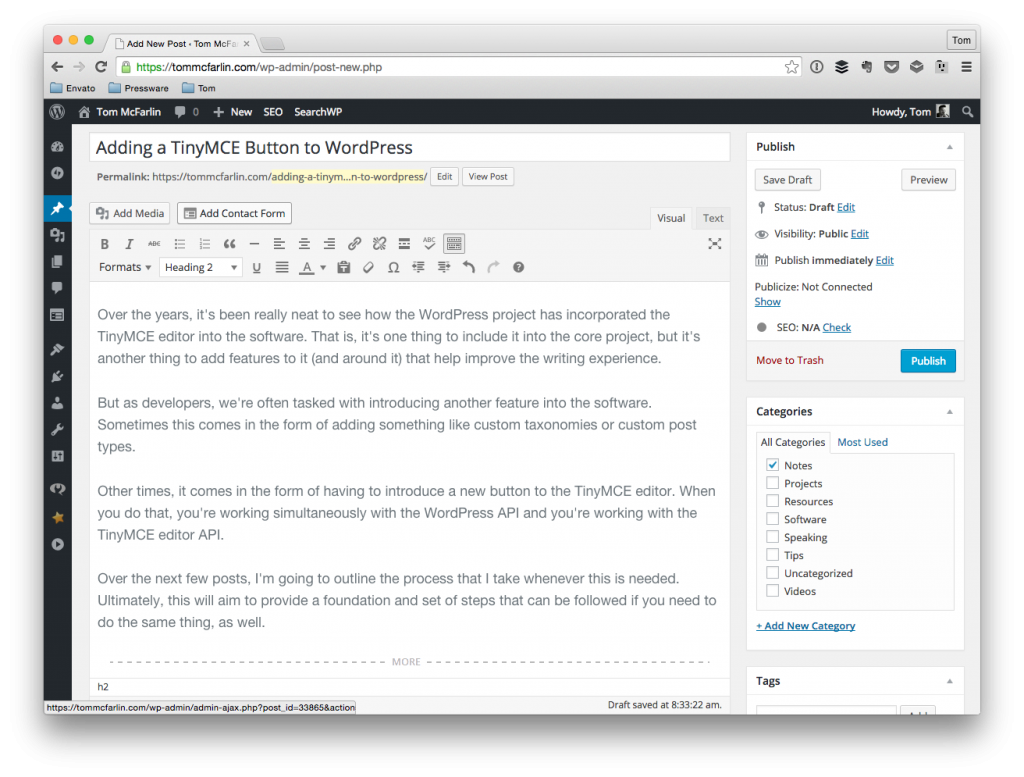
In the previous post in this series, I showed how to add content to the post editor using a custom TinyMCE button. The problem with the approach, as we’ve covered thus far, is that the content that we’re adding to the editor is hard-coded.

We’re rarely going to want to be doing this, right? I mean, wouldn’t we rather grab input from the user and then add that to the editor?

My very own copy TinyMCE Editor. Show spectacular.

My very own copy TinyMCE Editor. So spectacular.

For some, this may be creating a shortcode based on some input, for others it may be grabbing input, making an Ajax call, and then putting the result of the request into the editor, or it may be something as simple as taking whatever input the user has provided in a prompt and then adding it to the editor.

Though the latter case is not likely something that is a realistic use case (after all, if they just wanted to put something into the editor, why not just, you know, enter it into the editor?), it’s something that will make rounding out this series a bit more complete because it will show how to connect displaying a prompt to the user, grabbing the input, then using the TinyMCE API to drop the input into the editor.

So that’s what we’ll do.

Continue reading

How To Save WordPress Submenu Page Options

If you’re using functions such as add_menu_page or add_submenu_page to create pages in the WordPress dashboard, it’s pretty easy to get something up and going, but what if you’re looking to actually save WordPress submenu page options?

Submenu Page Options

That is, let’s say you’re creating a page in the dashboard that’s tied to a new menu item – perhaps something that’s being added to the Tools menu – and you want to display some options among some other text or some other element or set of elements that you’re displaying.

It’s completely possible to use the Settings API to do exactly that, but it may also be a little heavy-handed for saving a couple a small set of options.

Luckily, WordPress has a hook that’s available that makes it pretty easy to save information like this that’s completely usable outside of the Settings API.
Continue reading

jQuery is Undefined

For those who have been in web development for sometime – especially those who have seen the rise (and stuck with) jQuery – then you’re likely all too familiar with some of the potential errors messages that you may see when working with the library.

But if you’re someone who is just starting out and perhaps you’re learning JavaScript and/or jQuery and you’re getting familiar with the developer tools that ship with your browser of choice, you’ve got your plate full of things that you’re having to debug.

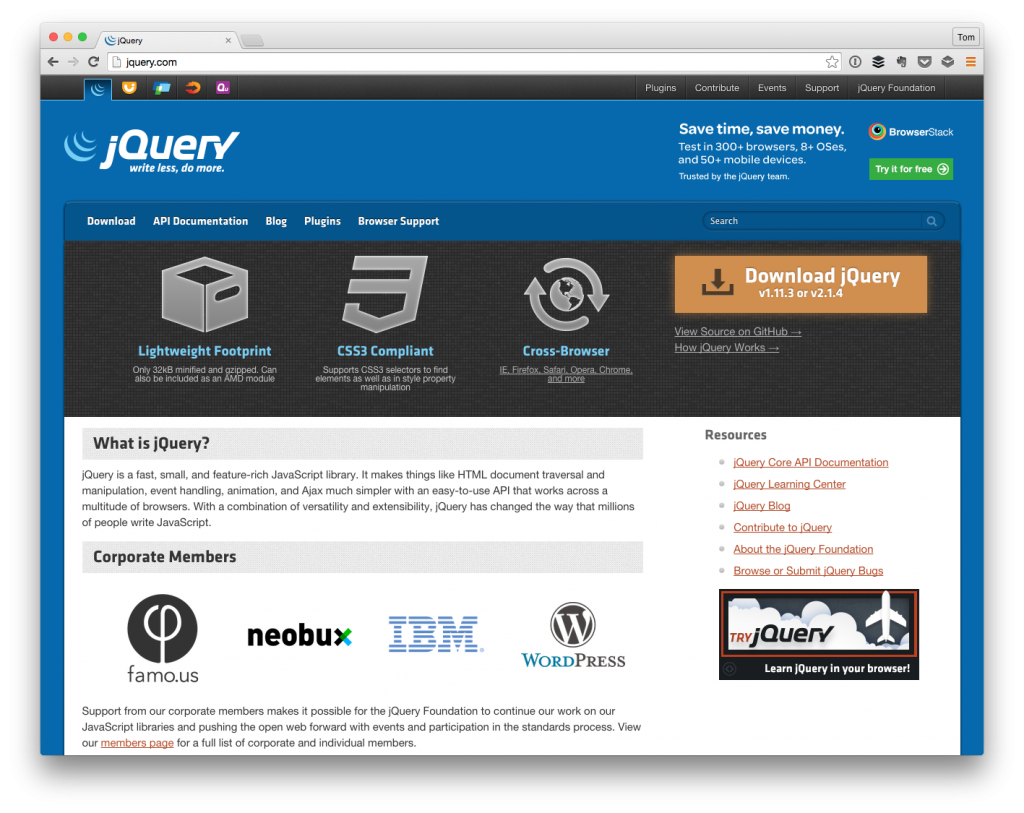
jQuery

And sure, Google is your friend and being able to ask questions on sites such as Stack Overflow and other similar sites is nice (though the community may not always be such), but it’s not always fruitful.

In those cases, I think those of us who have gone down the same road that you’re traveling have some obligation to help educate what the problem is, why it’s happening, and how to resolve it.

And that’s what I’ve tried to to do in my most recent article for Envato.

Continue reading

Being a Pragmatic Programmer in WordPress

One of the things that I’ve begun to think about as I move through my career in development is what it means to be truly pragmatic about the work that I do.

But first (and no, this is not an affiliate promotion), I think it’s worth noting that The Pragmatic Programmer is a book that I think every person who is a developer of some sort should reading (maybe several times, even). It’s an easy read and brings up a lot of good points as it relates to being the best programmer that you can be as it relates to best practices (whatever that may look like for your slice of the industry).

Anyway, I’ve talked about the tension of having to stay on top of every new technology that’s released as well as the importance of going deep rather than wide as it relates to the work that we’re doing on a day-to-day basis.

Continue reading

Experiences in Growing a Business in WordPress

Self-employment, freelancing, and/or contract work can be a funny thing especially if you’re a one man shop. I think that the freedom that comes with working alone has its benefits – I mean, you’re running the whole show – but it also has its drawbacks – you’re running the whole show.

By that, I mean when it comes to working on contracts for others, there’s a lot of satisfaction to be found is providing solutions for them, but it’s also a lot to juggle behind-the-scenes (payroll, accounting, expense reports, etc.).

And yes, I absolutely recommend finding people who are skilled in that area and then paying them to take care of that stuff for you (after all, it’s what they like to do) so that you can focus on what you like to do.

But that’s just one aspect of what it means to running your own business and it’s not the aspect that I’m interested in talking about right now.

What about the part where you start growing your business? Or the part where you’re looking to partner up with someone else or have additional contractors or employees come on board so that you can expand what it is that you offer?

As exciting as that can be, it also carries its nuances, as well.

Continue reading

« Older posts Newer posts »

© 2026 Tom McFarlin

Theme by Anders NorenUp ↑