Software Engineering in Web Development, Backend Services, and More

Tag: WordPress (Page 174 of 220)

Articles, tips, and resources for WordPress-based development.

How To Add Google Fonts To The WordPress Editor

When it comes to building themes in WordPress, one of the nicest things that you can do for your users is to implement a stylesheet specifically for the editor so that they get a true WYSIWYG experience.

To be more specific, that is you can (and should!) add a stylesheet specifically for the WYSIWYG editor in the WordPress Dashboard. This stylesheet is normally called `editor-style.css`, but can actually be called whatever it is that you’d like permitting that you enqueue it properly.

With the popularity of web fonts rising – such as those from Google – you have to take a slightly different approach when implementing them in the context of the editor rather than the typical way of doing so with server side hooks.

Continue reading

A Strategy To Separate Comments and Pingbacks in WordPress

One of the luxuries offered by WordPress – in addition to the commenting system – is the ability to know when someone has given us a ping or a trackback by mentioning us through another blog and linking back to a given post.

If you’ve ever developed themes, then you’re familiar with the need to display both comments and trackbacks someone in the single post page; however, sometimes you want to separate the two from one another so not to clutter the discussion.

The WordPress API makes this possible in a couple of ways, but there’s one way that I find myself preferring over the others for which I tend to think lends itself to cleaner code, though I’m interested in your feedback on this.

Continue reading

Update Your WordPress Projects on GitHub with the GitHub Updater

It’s no secret that many open source developers love GitHub – it’s an amazing service that makes sharing and working on open source projects really easy, both from a project management standpoint, and from a developer/contributor standpoint.

But if you’re in the business of building WordPress plugins, and you enjoy taking advantage of the services offered by the GitHub plugin repository, then one of the things that makes it difficult to keep your work on GitHub is the lack of ability to update your plugin.

Of course, projects have been released that allow you to sync both repositories, but if you’re interested in going 100% with GitHub, then check out the GitHub Updater Plugin.

Continue reading

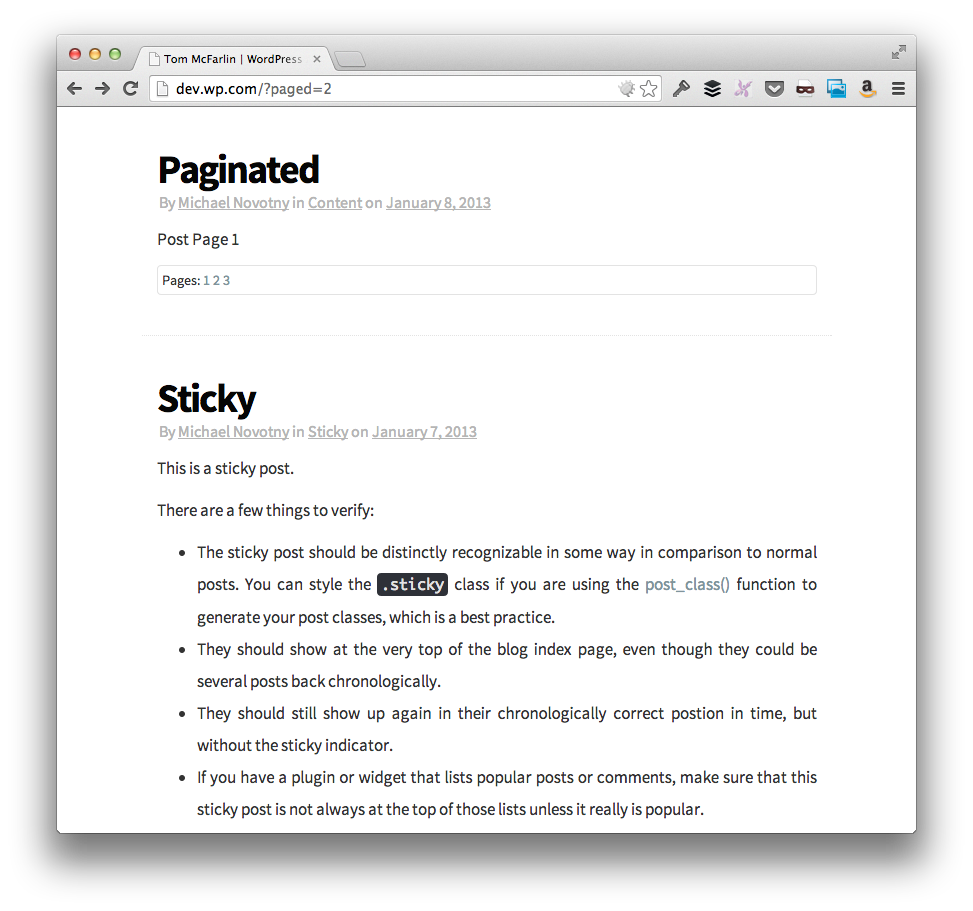
An Easy Way To Check if a Post is Paginated

Out of the box, WordPress supports the ability to paginate individual posts.

For those who aren’t familiar, it means that you’re able to literally paginate your posts such that a post may consist of multiple pages (kind of a weird concept, huh?).

Paginated Posts

Some people may use this feature, some people may not; however, if you’re working on a theme, then you need to be prepared for this case and provide appropriate styling.

But the way if which you determine if a post is paginated or not can lead to a bit of cluttered code, so in order to keep the code as readable as possible (and to keep the logic separated from the template), here’s one way that you can check is a post is paginated.

Continue reading

On Using Helper Files in WordPress

One of the things that I appreciate about certain application development frameworks is their approach to convention over configuration.

By that, I mean that they tend to take the approach of “a place for everything, and everything in its place” rather than setting a ton of variables in a set of different files to tell the core system where everything is located.

In my opinion, WordPress is a little bit of hybrid of this kind of stuff, but I tend to look at it in the direction of modifying configuration files.

After all, we have both `wp-config.php` and we have `functions.php`. Both of these serve their purpose, but `functions.php` can get specifically cluttered as a theme or an application grows.

Continue reading

« Older posts Newer posts »

© 2026 Tom McFarlin

Theme by Anders NorenUp ↑