
Software Engineering in WordPress, PHP, and Backend Development

Author: Tom (Page 287 of 429)

A Rule of Thumb for WordPress Partials

For anyone who has worked with WordPress on some level, you’re likely familiar with the concept of templates.

In the context of WordPress, templates are the files in which information retrieved from the database is rendered. In other frameworks or platforms, they may also be called templates, but are also often referred to as views.

But for anyone who has done enough work with building web applications, you know that as much as we like to build reusable components on the server-side – be it functions, classes, or whatever else – that we also like to do so with client-side related code, too.

Continue reading

Markdown Syntax (And Developer’s Tunnel Vision)

As far and and as exciting as text editing can get, one of my favorite introductions into the space in the last decade has been Markdown.

I remember the first time I read about it, I loved it – it was essentially simplified markup – and the first time I used it regularly was when Stack Overflow launched.

Then I began to write my text files using the format even if the tool didn’t support formatting because it help to make reading the text file that much cleaner (besides, sometimes word processors are just overkill, aren’t they?).

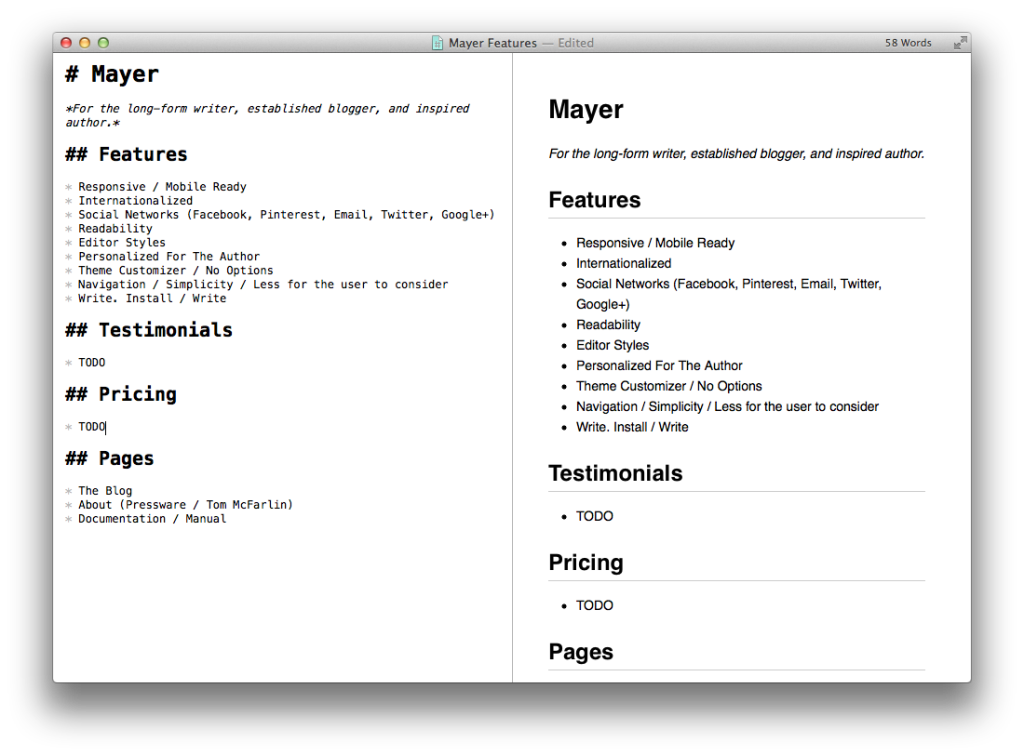
Notes for Mayer in Markdown

Notes for Mayer in Markdown

Then other development-oriented sites began implementing markdown parsers into their site much like Stack Overflow did when they started. For developers and others who enjoy writing in markdown, it’s been a really cool ride.

With tools and services like:

I’d say that markdown is more prevalent than it’s ever been.

And although I’m someone who clearly is clearly a fan, I can’t help but think that developers are developing a bit of tunnel vision as it relates to a way for everyone to write.

Continue reading

The Best Programming Language, Tool, and Technology is Here!

I think one of the biggest challenges that developers face – especially new developers – is this feeling of having the keep up with the newest, latest, and greatest technologies that come out almost monthly (if not weekly), and the guilt that follows when peers attempt to “hold them accountable” (for lack of a much better phrase) for not knowing or not using something.

Now, for the record, when it comes to the technologies that people opt to use for their projects, I don’t really care – to each his or her own. Whatever makes you more productive and gets you solving problems faster, then awesome.

Sure, there’s something to be said for a team using a unified set of tools, but that’s content for another post.

Generally speaking, can’t we stop with espousing every latest-and-greatest language, tool, framework, whatever as the next best thing?

Because it’s probably not.

Continue reading

How To Retrieve Posts with Multiple Taxonomies

Get Posts with Multiple Taxonomies

I think that one of the more underestimated aspects of building solutions with WordPress comes with leveraging custom post types and custom taxonomies.

For those who are currently building products for others – be it plugins, custom themes, or web applications – then you’re likely familiar with how powerful these two features can be.

Specifically, if you’re used to the ideas of models and views, or data objects and a presentation layer (or whatever language your framework of choice uses to describe this information), you can think of custom post types as a bit of a hybrid of models and views.

Similarly, you can think of taxonomies as an easy way to stamp your data – in WordPress, we think of these as categories and tags – but sometimes, I think the terminology may limit us in thinking how we can leverage the features.

Nonetheless, if you’re used to working with WordPress, custom post types, and custom taxonomies, then you’ve likely faced a time when you’ve needed to query information based on a combination of the two.

And though there are a variety of different ways to retrieve custom post types and how they are tagged, here’s one way to grab information that’s stamped with multiple taxonomies.

Continue reading
Believe The Best (Don’t Assume The Worst) About Your Fellow Programmer

Developers can be very quick to judge another developer’s work – be it code, a blog post, or even a tweet – as to why they would opt to share one method of solving a problem rather than another.

And that’s a bit of paradox, isn’t it?

I mean, developers know that for any given problem, there are likely multiple solutions, yet they often challenge why one solution was chosen – or at least shared – over another situation.

And it’s not enough to actually challenge it, but it’s gotta be done with condescension or passive aggressiveness; otherwise, it’s just not enough, is it?

Continue reading

« Older posts Newer posts »

© 2026 Tom McFarlin

Theme by Anders NorenUp ↑