Software Engineering in WordPress, PHP, and Backend Development

Category: Articles (Page 248 of 258)

Personal opinions and how-to’s that I’ve written both here and as contributions to other blogs.

My Strategy For Organizing JavaScript in WordPress

Yesterday, I shared my strategy for using LESS in WordPress and enjoyed the comments that followed. In that post, I also mentioned that I have a similar strategy that I use to maintain my JavaScript files.

This particular aspect of development is one that I’m still experimenting with; however, there are certain aspects of it that have remained constant.

To follow up with yesterday’s post, I thought I’d share several things that I’ve consistently done that have improved development as well as some of the things that I’m currently doing that are proving to be useful.

With that said, here’s my current strategy for organizing JavaScript in WordPress.
Continue reading

Going Above and Beyond The WordPress Coding Standards

Recently, fellow tweep @Krogsgard asked about some of the things that I do to go above and beyond the basic set of WordPress Coding Standards.

To be clear, I think that the Coding Standards are the foundation on which you need to be building your coding style. They’re the foundation of writing professional-grade code for WordPress, so start with that and build on top of it.

Everything else is just bonus.

So, with that said, here’s what I try to do to go above and beyond the WordPress Coding Standards.

Continue reading

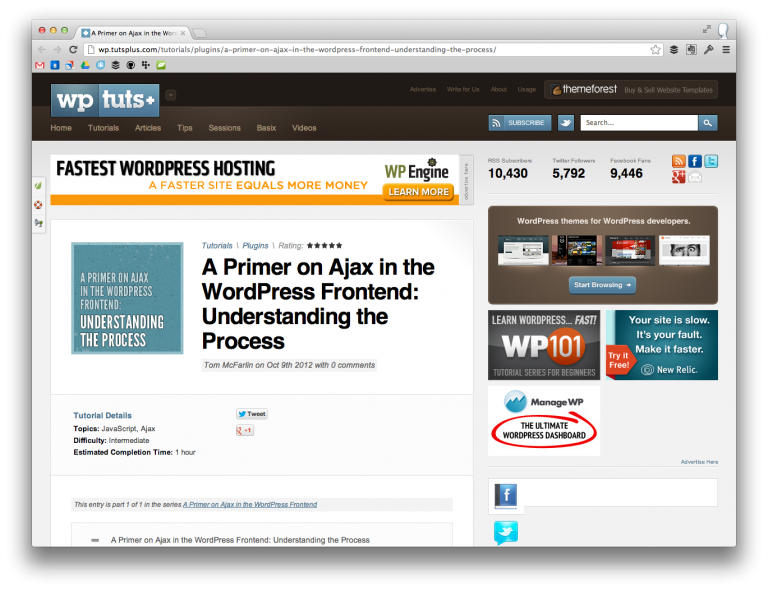
Ajax in WordPress: How It Works, Building a Plugin, and More

Ajax in WordPress

A couple of months ago, I did a short series on Envato on Ajax in the WordPress Dashboard. This month, I’m continuing to talk about Ajax in WordPress and how to include it on the frontend in your themes, plugins, and other projects.

Though the Codex has two great articles on Ajax in WordPress – that is, the introduction and how to use it on the server-side – there’s not a lot of documentation for how to implement it on the front end

Continue reading

What Constitutes Clean Code in WordPress?

When it comes to writing code specifically for WordPress, I try my best to follow a combination of the WordPress coding standards, tips and advice from various books I’ve read (which I hope to cover in a future post), tips from others in the community, and certain habits that I’ve developed along way the way.

The thing that I’ve always struggled with determining is what constitutes clean code. There is code that follows standards, then there’s clean code, and I think that the definition is almost somewhat subjective.

With the open source nature of WordPress, the desire to improve education around the platform, the desire to improve the plugins repository, and the existence of things such as Theme Review team, Theme Unit Test, and tools specifically for helping us write code, there’s an innate desire for programmers to write clean code – I just think that we could do a better job defining it.

To be clear, I don’t believe that clean code is synonymous with quality code, nor do I believe that clean code is synonymous with good code. They’re absolutely all related, but they aren’t the same thing.

With said, what does constitute clean code specifically in the context of WordPress development?

Continue reading

« Older posts Newer posts »

© 2026 Tom McFarlin

Theme by Anders NorenUp ↑