Software Engineering in WordPress, PHP, and Backend Development

Category: Articles (Page 179 of 258)

Personal opinions and how-to’s that I’ve written both here and as contributions to other blogs.

Setting Routines and Boundaries for Self-Employment

About four months ago, I received the following comment on one of my blog posts:

I’d love to hear some thoughts, maybe in a future post, on setting boundaries and establishing routines. My ideal would be to have already been to the gym, at my co working space and starting work by 8:30, finished by 6pm, no exceptions. Despite my best laid plans, I haven’t been to the gym in 2 weeks, I find myself starting work any time between 7am and 11am, and occasionally working late into the night once my son is in bed. Some people dig this freedom, but I find that I crave some structure – I just reject having it imposed on my by an employer.

For some time, I’ve sat on this particular topic because it’s something that I’ve wanted to write about, but either had a backlog of other things I wanted to cover, or it didn’t fit with the type of content I was trying to publish at the given time.

Boundaries of Self Employment

yes – working near your tv is risky business!

But now seems like a good time to look into this: Partially because I’m preparing a few posts that are dealing with a number of tools that I use to get things done, partially because a number of people I know who work from home have shared the same feelings, and partially because this is something that I’ve been doing for the past seven years or so.

But for those of you who want to skip the entire post, here’s the TL;DR:

It depends on your personality type.

Honestly, though, there’s more to it than that.

Continue reading

Minimizing Distractions For Programming

For anyone who’s been programming long enough, I’d venture to say that some of the most productive times of the day come when you’re in the zone.

You know what I mean, too: When you’re minimizing distractions, when you’re listening to whatever music helps you get into the groove, and whatever you’re working on feels almost effortless (not that it doesn’t come with it’s share frustration, but you’re just there and totally focused on the task at hand).

We know this feel.

We know this feel.

At the same time, I think that it’s incredible that we get as much work done as we do. Granted, we all have different ways in which we work, but at any given time I could have the following applications open:

  • Email
  • Twitter
  • Slack (for chat)
  • Google Hangouts
  • Feedly
  • Downcast
  • Notifications from my phone (or tablet)
  • …and so on

And that’s in addition to my IDE. I’m sure the same can be said about you and your environment, too. But here’s the thing: Each of the above contributes to making sure we’re aware as many demands that we have being placed on us, but can you argue that they all make us more productive?
Continue reading

Writing Good Software Takes Time

One of the things that the Internet has brought with it is this on demand culture. We can talk to people on demand, we can request information on demand, we can complain on demand, we can praise on demand, we can listen to music on demand, we can publish a blog post on demand, we can stream movies on demand.

Almost anything that you think of that can be done online can be done on demand.

Though we’re now in an age of virtual machines, byte code, interpreted languages, and far away from punch cards, writing good software is not something that can be done well on demand. This isn’t to say that we don’t have tools that help us move more quickly through the process of assembling various components – because we obviously do – but building software for yourself just as well as for others is something that takes time.

Hunter S. Thompson once said:

Anything worth doing, is worth doing right.

Granted, the idea of what is “right” in writing software is something that can be debated, but one thing that it cannot be argued is that it should be done quickly.

But when you’re surrounded by so many things in your life that can be done on demand, it’s hard to forget the opposite still exists and is a viable, arguably better option.

Continue reading

WordPress’ Related Posts and Featured Images (Yes, Again)

About two months ago, I wrote about the usability of WordPress featured images.

Though nothing has changed in the last few months, there has been one use case that I find leans in the direction of supporting featured images despite their potential improvement for usability. Specifically, it deals with using the Related Posts feature of Jetpack.

Related Posts without Featured Images

Related Posts without Featured Images

For those who are new to WordPress or this specific feature of Jetpack, Related Posts makes it really easy to add links to similar posts at the end of each post:

The Related Posts feature scans all of your posts, analyzes them, and lets you show contextual posts your visitors might be interested in reading after they’re done with whatever post they’re on.

Nice, right?

Continue reading

The WordPress Way (We’re Doing It Wrong)

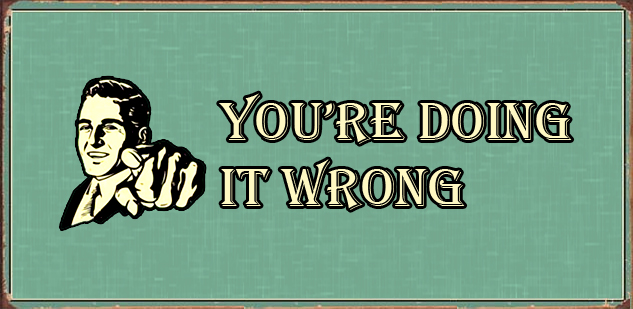
For years, the whole “doing_it_wrong” meme has permeated the WordPress development community. Generally speaking, I think that it’s been toned down quite a bit in the last year or two and I consider that a good thing, but recently I’ve begun to see people say they are being chastised for not doing things “the WordPress way.”

You're Doing It Wrong

Granted, this may be something that’s been going on for far longer than I’m aware, but the fact that it’s beginning to reach a point at which we’re seeing a number of different people share this feeling in blog comments is, at the very least, interesting (if not a bit disconcerting).

Honestly, I’m of two minds about it: Telling someone they are “doing_it_wrong” is negative – it’s condescending. And perhaps telling people they aren’t doing it “the WordPress way” is just a flip side of the same coin, but I also think that it just has a more positive, approachable spin to it (depending on how it’s shared, I guess).

Whenever anyone starts off a discussion with a negative then proceeds to tell you why you’re wrong, you can’t help but feel a bit defensive and possibly even offended.

Using a more positive approach yields better conversation, doesn’t it?

And I think there’s something about “the WordPress way” that is more accessible and approachable. Though it still indicates that something isn’t being done correctly, it does come with the implication of “this isn’t the WordPress way, here’s how you should be doing it, and here’s why you should be doing it this way.”

And in that respect, it does matter whether or not we’re doing something correctly within the context of our software.

Continue reading

« Older posts Newer posts »

© 2026 Tom McFarlin

Theme by Anders NorenUp ↑