Software Engineering in WordPress, PHP, and Backend Development

Category: Articles (Page 178 of 258)

Personal opinions and how-to’s that I’ve written both here and as contributions to other blogs.

Is There Room to Improve Error Logging in WordPress?

I think that one of the best ways to stay current with whatever tools, languages, etc. that you’re working with is to take a look and see what other communities are doing with their tools.

For what it’s worth, I also think that bringing experience from previous projects and/or jobs to new projects and/or jobs is important – you get a chance to continue doing all of the things that worked well, a chance to avoid the things that didn’t work, and a chance to discover a new set of things that work and things that don’t.

One of the more popular tools to come out as of late is Docker. There are a lot of really cool things about it, and there are a lot of articles already being written about it. I recently read one that struck a chord with me and with WordPress-related development.

Especially this quote:

Logging is a critical part of running an application. It’s often undercooked because it’s been here for so long no one think about it anymore. But trust me, when things stop logging, admins start crying.
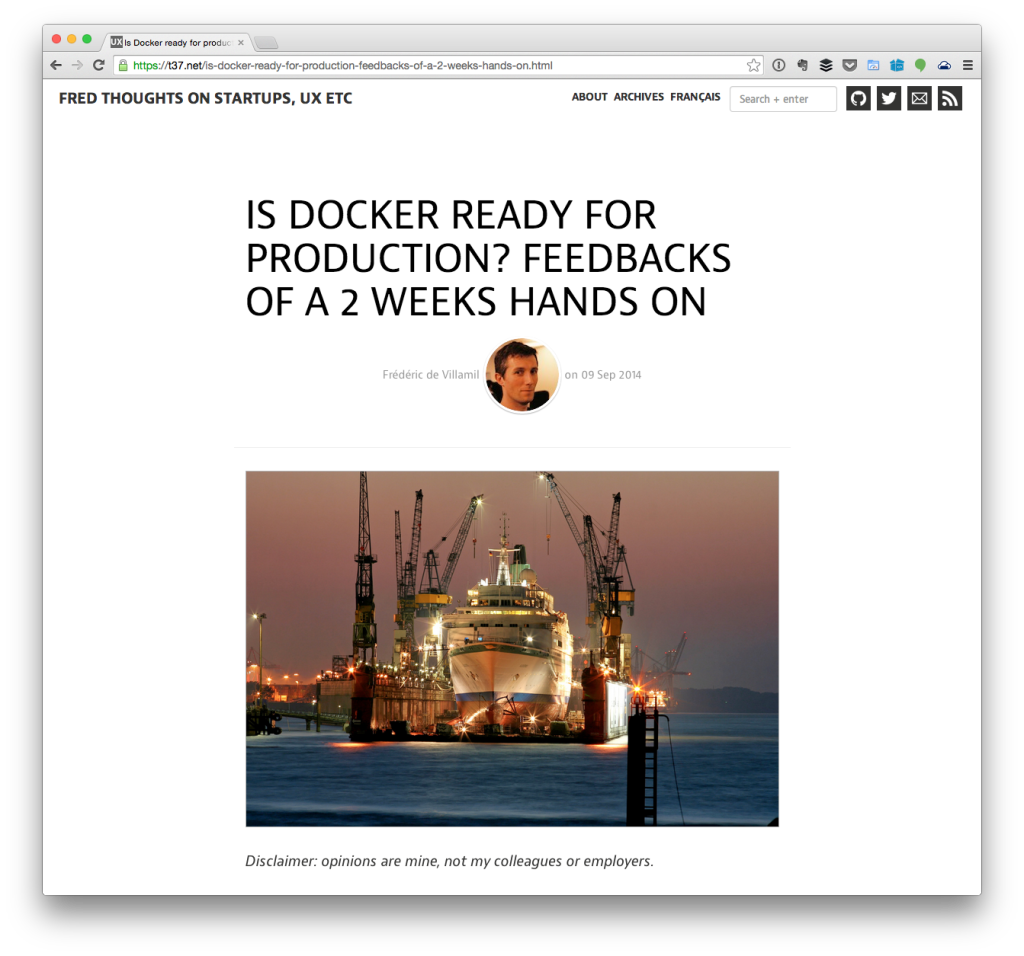
Is Docker Ready For Production?

Yes, it’s a good read for anyone who likes to see how other developers are doing their thing in another area of the industry and there’s a number of points made that I think many people who have been working in software for a number of years can identify with, but I couldn’t help but ask myself if I’m doing (or we’re doing) enough logging in the WordPress projects I’m (or we’re) deploying.

Continue reading

WordPress and The Single Responsibility Principle

I love the fact that people are working to bring more advanced object-oriented programming techniques to WordPress-related development.

That is, I’m really glad to see others are pushing for people to write more truly object-oriented code rather than using classes as a “poor man’s namespace” (ht to Franz for that nickname), or doing things like setting up hooks outside of a constructor.

To be fair, he had more than one responsibility.

he had more than one responsibility.

To be fair, I’m as guilty as the next for not always writing very good object-oriented code in the context of WordPress (though I’m slowly working to change that – hopefully the Plugin Boilerplate is proof-positive of that), and I think it’s something that we should all be striving to get better at doing.

Continue reading

“When Should I Use Ajax?” and Other Mysteries of the Web

A few months ago, I published a post that covered how to achieve single page tabbed navigation in WordPress. In the post, I mentioned the following:

In some cases, it may be best to load pages via Ajax, in some cases, it’s better to load things up all in the first page load.

Generally speaking, I stand by this statement. I know Ajax is fun and I know that it’s gotten incredibly easy to implement, but there are times where it makes sense to load all information with the page and times when said loading should be done asynchronously.

In the comments, someone asked:

I am also very interested and awaiting post regarding your take on when to use ajax and when to load it all.

Though this could have been answered in the comments, it seems as if this is an ongoing discussion among those who build things for the web, so I thought I’d take the time to answer it in the form of a post. If nothing else, perhaps it will spark you to share some of your opinions on it, as well.

Continue reading

Maintainable WordPress Meta Boxes

The comments on this post are closed. Please leave your feedback on each of the respective articles.

When it comes to enhancing the functionality of the CMS, WordPress meta boxes are one of the most flexible features that we can introduce to the post editor screen.

In short, they’re a way that we can open additional fields to one, some, or all of the existing post types as well as custom post types. They also make it possible to introduce a number of different type of elements – be it input fields, textareas, checkboxes, etc. – so that users can easily view, add, and/or modify data associated with a given post.

When it comes to writing meta boxes, especially those that are more elaborate than others, it can become a bit of chore to maintain the code over time. But it doesn’t have to be that way.

Continue reading

Become a Better Programmer. Just Like You.

Hang around any community long enough and you are going to see the good parts, the bad parts, and the weird parts . Similarly, I think that anyone who has been involved in any type of community for a significant amount of time will have plenty to complain about.

I’m not just talking about online communities either – this is just as applicable online as it is offline.

But, if you’re reading this, then you’re reading this online and odds are you’re active on Twitter or Facebook or some other form of social media where we all use the services as our own platform for sharing our opinions with the public where others can read, respond well, respond negatively, or ignore.

Whatever the case, I think that we’ve gotten far too comfortable sharing our criticisms in 140 characters or less without showing enough empathy or understanding or education for our peers and it’s to our own detriment that this is happening.
Continue reading

« Older posts Newer posts »

© 2026 Tom McFarlin

Theme by Anders NorenUp ↑